In Part 2 of Pre-Cataclysmic Architecture — The Lost Architects Series — we place our hands on the impossible stones themselves. Across Peru, Egypt, Lebanon, and Bolivia, these monuments reveal feats of engineering that modern machines struggle to replicate. How were mountains moved?
Last time, we walked into a forgotten world — a world where stone spoke louder than history. Today, let’s step deeper.
Let’s place our hands on the stones themselves — vast, heavy, impossible stones — and ask: How were these monuments created?
We live in an age of cranes and machines, yet the builders of the distant past moved and placed stones that would challenge even our modern capabilities.
How?
As you’ll see, when we try to replicate their feats, we often fail — and what the stones reveal is not just strength, but an intelligence in architecture that still humbles us today.
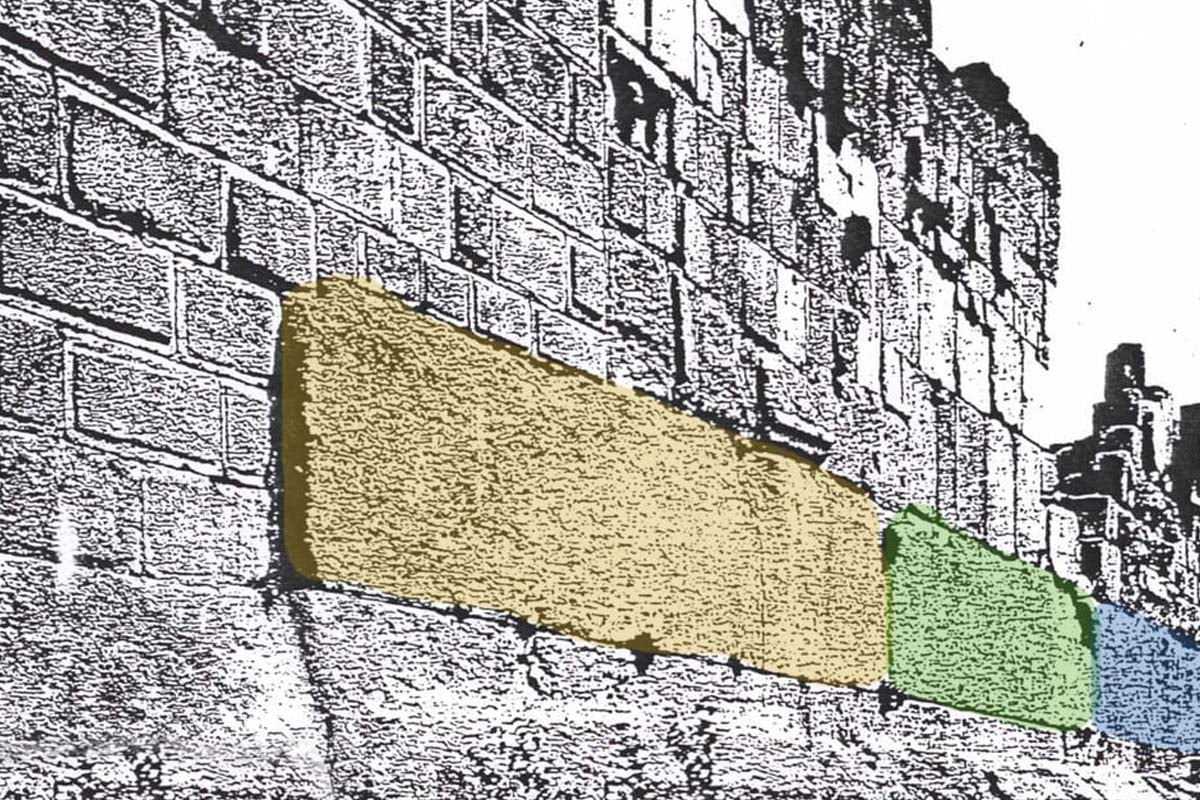
In the Bekaa Valley of Lebanon stands the ancient site of Baalbek.
Here lies the Trilithon — three stones weighing an estimated 800 tons each, forming part of the temple platform.
For comparison:
A loaded Boeing 747 weighs about 400 tons.
These stones are twice that.
Each block measures about 19 meters long, 4.5 meters wide, and 3.6 meters high.
They weren’t just cut.
They were transported from a quarry nearly a kilometer away.
Then lifted into place, 7 meters above ground level.
No ancient writings explain how it was done.
Modern engineers propose:
Huge earth ramps?
Wooden rollers?
Thousands of laborers?
But no one has successfully replicated the movement and placement of such massive stones using ancient methods.
In fact, moving an 800-ton block with wooden rollers would crush the wood before it even started rolling.
It’s easy to theorize.
Much harder to do.
As historian Andrew Collins once said:
“If it were easy to do, we would have seen it done again.”
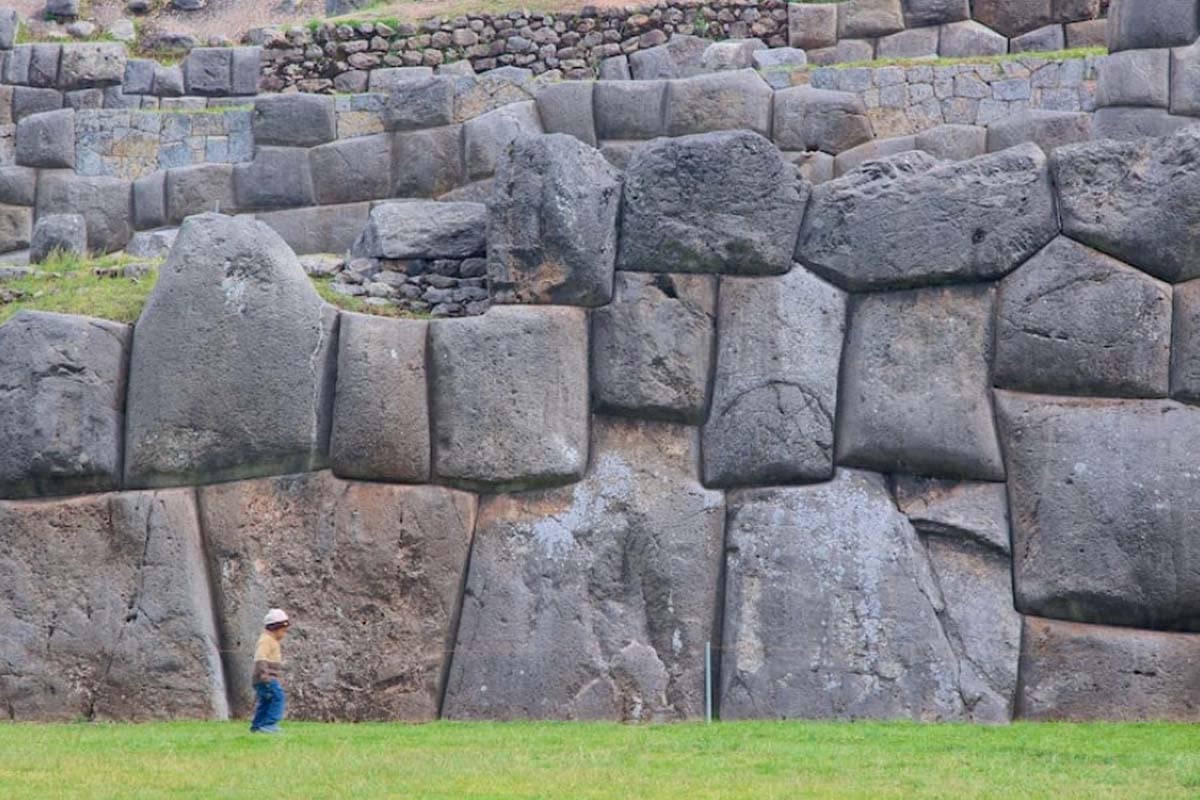
High above Cusco, Peru, lies the fortress of Sacsayhuamán.
Massive limestone blocks, some over 125 tons, fit together with such incredible precision that not even a razor blade can slip between them.
The stones are not simple rectangles.
Each one has a unique, multi-angled, interlocking shape — like a massive 3D jigsaw puzzle.
And here’s the mystery:
No mortar was used.
The stones were shaped and locked so perfectly that earthquakes — which regularly devastate modern Cusco — have left Sacsayhuamán standing.
Local legends claim that the site was built by a race of giants or gods.
The Inca themselves said it was ancient even in their time.
Some modern scholars suggest tens of thousands of workers using bronze chisels and stone hammers could have shaped these walls.
But shaping and fitting 100-ton blocks across rough terrain, without advanced surveying tools, remains unexplained.
If it were so easy, why don't we see such craftsmanship repeated in later periods?
Sacsayhuamán challenges not just our muscles — but our imagination.
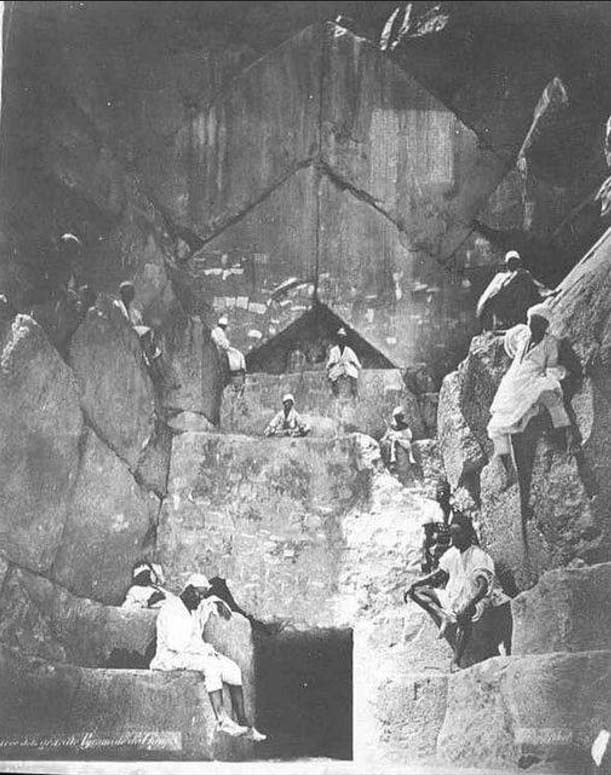
Standing before the Great Pyramid of Giza, you feel something deep shift inside you.
Built from 2.3 million blocks of stone, most weighing between 2 and 3 tons, with some granite blocks inside weighing up to 70 tons, the pyramid rises with an accuracy and scale that boggles the mind.
Alignment: The pyramid is aligned to true north within 3/60th of a degree — a level of precision that few modern buildings achieve.
Dimensions: Its base sides differ in length by less than 20 centimeters over 230 meters.
Volume: It remained the tallest human-made structure on Earth for over 3,800 years (most probable far more than that!).
Conventional archaeology teaches that ramps were used — huge, mile-long earthen ramps spiraling or straight.
Yet no physical evidence of such ramps has ever been found.
And constructing a ramp larger than the pyramid itself (only to dismantle it afterward) raises serious logistical questions.
In the 1970s, architect Mark Lehner and engineer Jean-Pierre Houdin proposed complex internal ramp theories, but so far, no definitive evidence has confirmed how the pyramid was actually built.
Some researchers, like Robert Bauval, point to the Orion correlation theory, suggesting the pyramids were aligned with stars as part of a cosmic plan — again implying a level of knowledge far beyond what we expect for the time.
Giza is not just a tomb.
It is a mathematical, astronomical, and architectural marvel.
And the mystery of its construction remains.
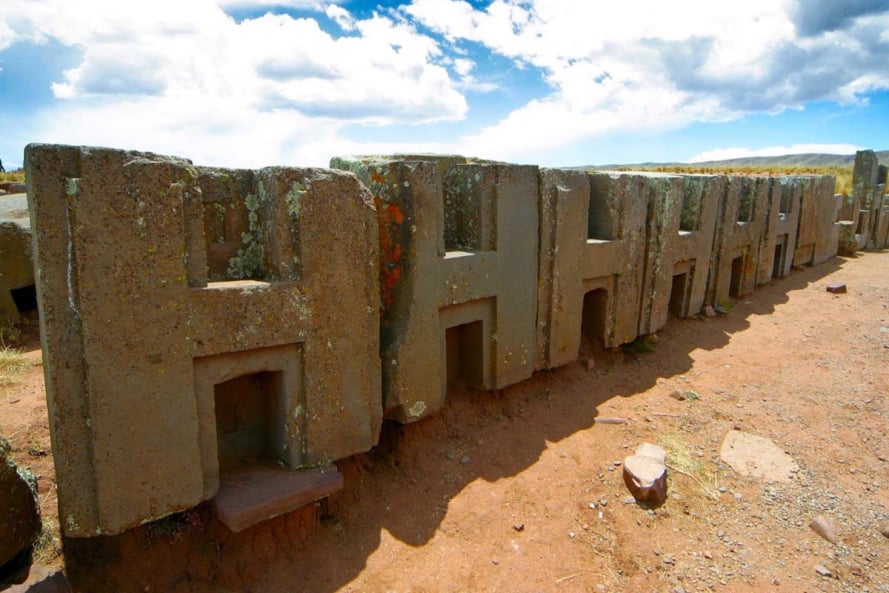
In Bolivia, at 12,800 feet above sea level, lies Puma Punku.
Here, the stones lie broken and scattered, but even in ruin, they reveal something astonishing:
Perfectly flat surfaces.
Razor-sharp edges.
Precise drill holes and 90-degree cuts in hard andesite stone.
These are the signatures not of rough hewing, but of high-precision machining.
Yet the Tiwanaku culture, credited with Puma Punku, had no written language, no metal tools, and no wheel.
Even with modern diamond-tipped drills and lasers, replicating the same cuts on hard andesite is challenging.
Researchers like engineer Christopher Dunn have argued that Puma Punku looks more like a collapsed modern factory than a primitive temple.
Of course, conventional archaeologists resist the idea of lost technologies.
They suggest that with lots of time, patience, and stone tools, the builders could have achieved these results.
But again:
If it were so simple, why do we not see similar craftsmanship elsewhere?
Puma Punku stands as one of the greatest architectural mysteries of the ancient world.
To solve the mystery, modern archaeologists and engineers have attempted to replicate ancient construction methods.
The results?
Humbling.
Stonehenge Experiments (1997):
130 volunteers attempted to move a 40-ton replica stone with ropes and rollers.
They could barely budge it until additional levers and tricks were added
Moai Moving on Easter Island:
Thor Heyerdahl’s team used 180 men to move a 10-ton statue on wooden sledges.
Scaling up to 80-ton statues would have been physically impossible without an army.
Pyramid Replication:
Small pyramid replicas were built using ramps and sleds.
But none approached the scale, precision, or efficiency of the Great Pyramid.
Bluestone Transport (Stonehenge 2001):
A volunteer project tried to move a 4-ton bluestone by land and sea.
The boat carrying the stone sank in the harbor before reaching open water.
Over and over again, when we try to replicate ancient construction using "primitive" methods, the reality is much harder than the theories suggest.
It’s easy to say "ropes and wood."
It’s another thing entirely to move and position a 150-ton stone.
Let’s look at the math:
A 150-ton stone weighs about 1.47 million newtons.
If the coefficient of friction for stone on wood is 0.3, you’d need 441,000 newtons of pulling force.
A strong human can exert about 300 newtons.
Thus, you would need around 1,470 people pulling in perfect unison — on flat ground — to move the stone.
Add in slopes, mud, uneven ground, and obstacles?
Forget it.
And even if you could move it horizontally, lifting it into place would require a completely different strategy.
The physics tells a simple story:
It’s theoretically possible — but practically nightmarish.
And the bigger the stones, the worse it gets.
So... How Did They Do It?
This leads us to a tantalizing possibility:
Perhaps the ancients knew something — about balance, sound, material science, or forces — that we have forgotten.
In the next part of our journey, we’ll explore the fascinating theories of lost technologies:
Geopolymers: Were stones cast rather than carved?
Acoustic levitation: Did they use sound to lift stones?
Electromagnetism: Did they tap into the energies of Earth?
Smart mechanical systems: Balance, pivot, and vibration mastery.
Whatever the truth is, the fact remains:
The stones endure.
The mystery remains.
And the story is only just beginning.
Standing before these massive stones, one feels a sense of deep humility.
They are not just relics.
They are messages — messages from a time when human beings, against all odds, mastered forces we barely understand.
They challenge our assumptions.
They invite our wonder.
They whisper:
There is more to history than we know.
If these mysteries ignite your heart and mind, you’re warmly invited to join the Atlantis & Ancient Civilizations Online Summit. There, seekers, researchers, and visionaries come together to explore the truths hidden in stone and time.
You can find out more HERE.

You accept our Cookie Policy when visiting our site.
Copyright, 2000-2026 by Geophilia, LLC.