In the final part of Pre-Cataclysmic Architecture — The Lost Architects Series — we dive into the ancient sciences and hidden technologies that may explain these impossible feats. From geopolymers to sound levitation, the echoes of lost knowledge are waiting to be remembered...
Over the past two journeys, we’ve walked among the impossible stones.
We’ve marveled at the scale, the precision, the endurance of monuments that outlasted civilizations.
And we’ve asked the natural question:
How did ancient builders achieve feats that challenge even modern technology?
Today, let’s dive into some of the most fascinating ideas.
Some grounded in science.
Some still shimmering on the edges of mystery.
What if the architects of the ancient world knew techniques and forces we have forgotten?
What if they held keys not just to building, but to understanding energy, resonance, and the very spirit of the Earth itself?
Let’s explore the forgotten science of the ancients.
Modern research continues to affirm the principles behind these ancient practices. Studies in biophilic design, which integrates nature into architectural planning, highlight how natural materials, strategic lighting, and spatial flow can reduce stress and promote emotional well-being. Research by Dr. Roger Ulrich found that hospital patients with views of nature recovered faster, reinforcing the importance of environmental harmony in healing and overall health.
Moreover, principles of sacred geometry, which are deeply embedded in both Vastu and Feng Shui, have been studied for their effects on human psychology. Shapes like the Golden Ratio, commonly found in nature and ancient structures, have been shown to create a sense of balance and aesthetic pleasure, influencing modern architectural design.
As Albert Einstein famously said, “Look deep into nature, and then you will understand everything better.” The principles of Vastu and Feng Shui invite us to do just that—integrate nature's wisdom into our spaces for better living.
Imagine carving a 150-ton block of limestone.
Now imagine something easier:
Mixing limestone slurry and pouring it into a mold.
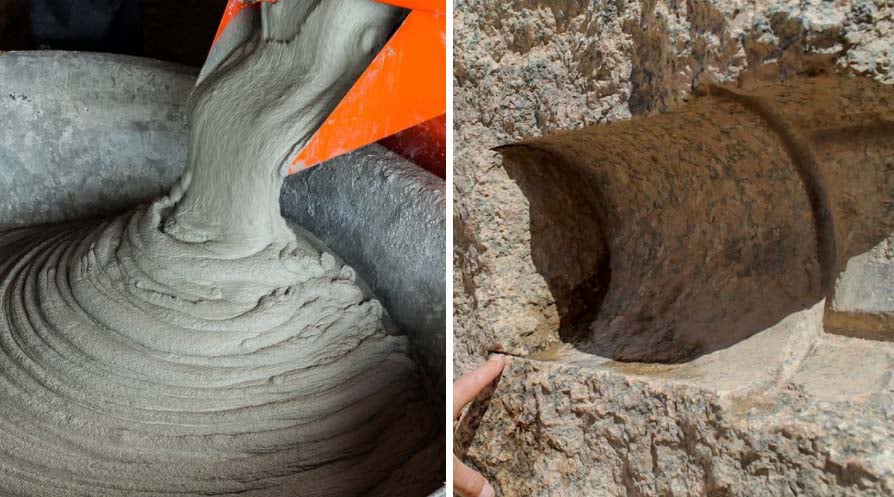
This is the idea behind the geopolymer theory — that ancient builders, especially in Egypt and South America, used chemical processes to cast stones rather than carving them.
French materials scientist Joseph Davidovits first proposed this in the 1970s after noticing strange microstructures in pyramid blocks.
He found that:
Some pyramid stones showed an amorphous (non-crystalline) structure, unusual for natural limestone.
The stones contained traces of minerals (like natron salts and clays) that suggest a reconstituted mixture.
Later, researchers like Michel Barsoum confirmed these findings using electron microscopy.
In essence:
Ancient builders dissolved limestone using natural acids and additives.
They then poured the material into wooden molds, letting it harden into perfect blocks.
Advantages?
No need to quarry and drag massive stones.
Easy to shape and align blocks with stunning precision.
Davidovits also proposed that at sites like Puma Punku, the intricate andesite blocks were cast from geopolymeric stone mixtures, explaining the machining-like precision.
If true, this radically shifts how we see ancient engineering.
Instead of brute force, they used chemistry — a lost art blending earth science and alchemy.
Of course, not all stones were cast.
Some monuments show clear signs of carving.
But geopolymer technology might explain many of the architectural wonders that still puzzle us today.
One major problem with the geopolymer theory is that to cast stone blocks, you would need frames or molds — something to pour the mixture into while it hardens.
And here’s the challenge:
At places like Sacsayhuamán, each stone is unique — different angles, shapes, and sizes, perfectly interlocking like a 3D puzzle.
If you had to cast each block individually, you would need hundreds or even thousands of different wooden frames, carefully customized for every single stone.
Building and maintaining that many molds, especially with ancient tools and resources, would be extremely difficult, nearly impossible.
Legends persist that the ancient Egyptians moved stones using sound.
Arab historian Abul Hasan Al-Masudi wrote that priests could strike stones with rods, causing them to float along lined pathways.
Tibetan monks are said to have used horns and drums to lift stones during monastery construction.
Is it all fantasy?
Modern science says: Maybe not entirely.
In laboratories today, researchers use acoustic levitation to suspend small objects — water droplets, styrofoam balls — in mid-air using high-frequency sound waves.
Sound carries energy.
At certain frequencies, sound waves create areas of high and low pressure that can counteract gravity.
While current technology only lifts tiny objects, the principles are real.
Some researchers speculate that:
Ancient builders may have used low-frequency resonance to vibrate and "loosen" the weight of massive stones.
Sound could reduce friction, making stones easier to move.
Sacred sites (like the Great Pyramid) might be acoustically tuned to harness natural resonances.
The Great Pyramid’s King’s Chamber exhibits strong resonant properties.
Its granite walls vibrate audibly when certain notes are sung.
Coincidence?
Or the echo of a deeper understanding of vibration, frequency, and energy?
Even if they didn’t "levitate" stones fully, the ancients may have used sound to manipulate mass in subtle ways, making transport far easier than brute pulling.
Another tantalizing theory:
Ancient builders tapped into Earth’s natural electromagnetic fields.
We know today that:
The Earth has a geomagnetic field.
Certain materials, like quartz in granite, respond strongly to electromagnetic forces.
Ley lines — hypothesized energy pathways — often intersect ancient sacred sites.
Some researchers propose that megalithic builders:
Placed stones along natural geomagnetic lines to harness Earth's energies.
Used piezoelectric effects (quartz under pressure generating electricity) to charge structures.
Built temples and pyramids as resonant energy devices, not just tombs.
The Great Pyramid’s location is curious:
It lies near the center of the Earth's land mass.
It sits atop powerful underground water aquifers.
Its dimensions encode mathematical constants like π (pi) and the Golden Ratio (φ).
Were the pyramids machines?
Were they amplifiers, antennas, or energy harvesters?
We don’t know for sure.
But the precision placement and materials suggest a level of energetic engineering we are only beginning to rediscover.

Another tantalizing theory:
Ancient builders tapped into Earth’s natural electromagnetic fields.
We know today that:
The Earth has a geomagnetic field.
Certain materials, like quartz in granite, respond strongly to electromagnetic forces.
Ley lines — hypothesized energy pathways — often intersect ancient sacred sites.
Some researchers propose that megalithic builders:
Placed stones along natural geomagnetic lines to harness Earth's energies.
Used piezoelectric effects (quartz under pressure generating electricity) to charge structures.
Built temples and pyramids as resonant energy devices, not just tombs.
The Great Pyramid’s location is curious:
It lies near the center of the Earth's land mass.
It sits atop powerful underground water aquifers.
Its dimensions encode mathematical constants like π (pi) and the Golden Ratio (φ).
Were the pyramids machines?
Were they amplifiers, antennas, or energy harvesters?
We don’t know for sure.
But the precision placement and materials suggest a level of energetic engineering we are only beginning to rediscover.
Across cultures, myths speak of a time when humanity wielded forgotten powers.
The Egyptians spoke of the "Sound Eye" that could move great weights.
The Sumerians told of tablets that could raise foundation stones.
The Vedas in India describe ancient flying machines (Vimanas) that used vibration and resonance.
Native American traditions speak of stones that moved by song.
Are these just myths?
Or fading memories of real, ancient sciences?
Modern science often dismisses myth.
But what if myth is memory encoded in story, waiting for an age that can understand it again?
Imagine standing among the ruins of Puma Punku or Baalbek.
Imagine the builders, thousands of years ago, singing to the stones, mixing earth and fire, shaping resonance and weight.
They did not see the Earth as dead matter.
They saw it as alive, humming, responsive.
Their architecture was not just functional.
It was sacred — an act of communion between humanity and the forces of nature.
In losing their technologies, perhaps we lost more than techniques.
Perhaps we lost a worldview — one where science and spirit were one, and where to build was to honor the Earth, the heavens, and the mystery between.
Today, as we peel back the layers of the past, we are not just rediscovering how they built.
We are rediscovering who we are
The stones are not done speaking.
New discoveries are happening all the time:
Satellite scans revealing buried ancient cities.
Materials science uncovering unknown compounds in ancient structures.
Experimental archaeology pushing the limits of what was possible.
The adventure is only beginning.
And maybe, just maybe, as we listen more closely, we’ll remember not just how to build grand monuments...
But how to build a civilization worthy of their legacy.
If these mysteries ignite your curiosity and wonder, you’re warmly invited to take the next step.
Join us at the Atlantis & Ancient Civilizations Online Summit, where seekers from around the world will come together to explore ancient technologies, forgotten knowledge, and the timeless truths woven into myth and memory.
Find out more HERE — the adventure is just beginning

You accept our Cookie Policy when visiting our site.
Copyright, 2000-2026 by Geophilia, LLC.